Evidence
A tamper-evident compliance evidence record
LLCR records what you held and when you held it in a cryptographic chain you can verify independently. Not a promise of outcomes. A structured record with integrity you can check.
The hash chain
What is hashed, and why alteration breaks the chain
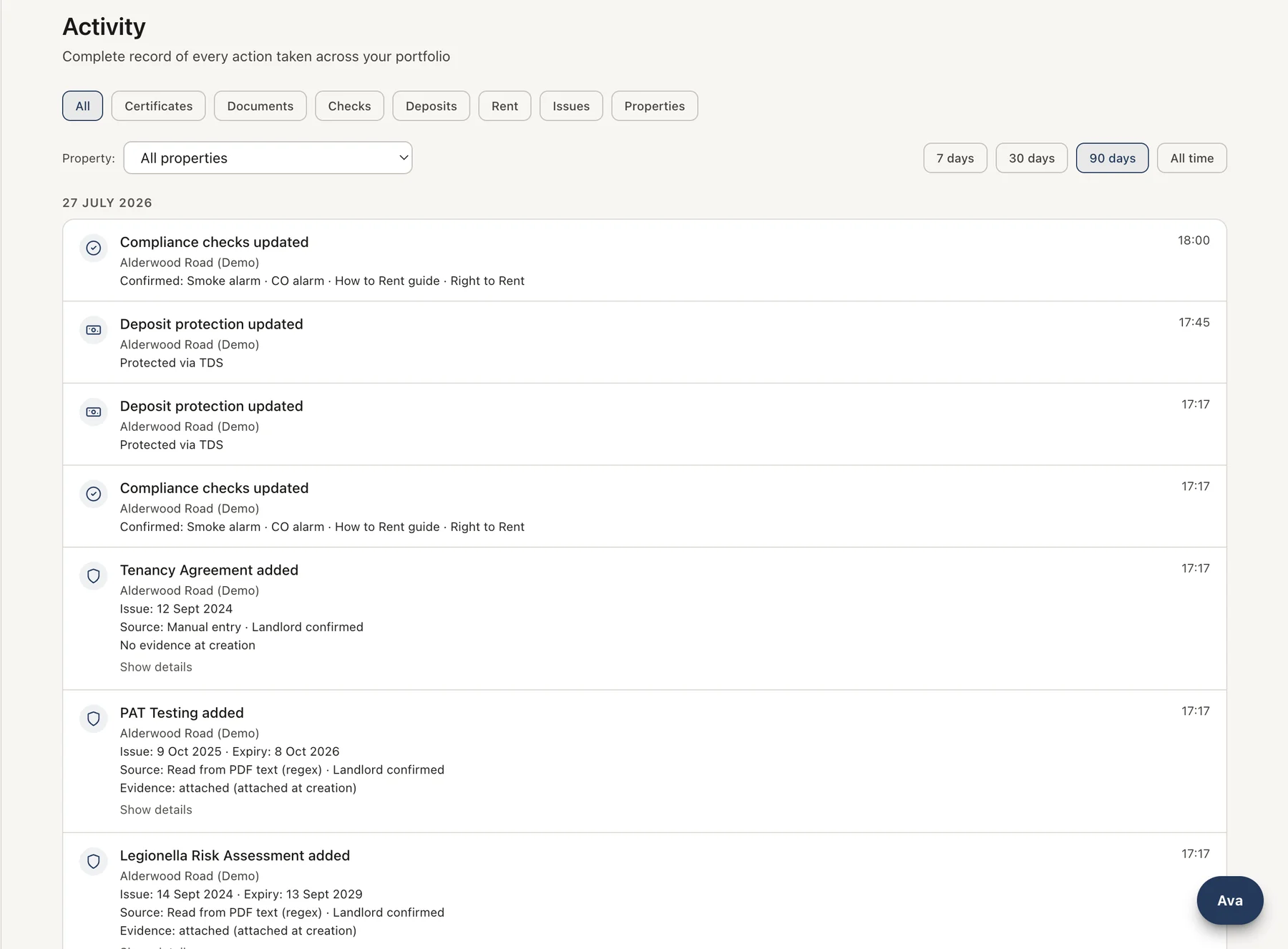
Every compliance action in LLCR (adding a certificate, uploading evidence, updating a record, logging proof of service) creates a SHA-256 hash of that event. Each new hash includes the hash of the entry before it, forming a continuous chain.
If anyone changed a single past record, its hash would no longer match. Every subsequent hash in the chain would break. The mismatch is visible immediately when you verify the chain, without asking LLCR whether the data is genuine.
This supports integrity of records as held in LLCR. It does not guarantee how a court, council, or redress scheme will treat your evidence.
Visual
How the chain links together
Each block depends on the one before it. Change any earlier entry and the chain no longer verifies.
Independent timestamping
OpenTimestamps in plain English
Once a day, LLCR computes a Merkle root: a single summary hash of all that day's audit entries. That root is submitted to OpenTimestamps, an open protocol that anchors data to the Bitcoin blockchain.
The timestamp does not depend on LLCR's servers alone. It is recorded on a public ledger no single party controls. Anyone with the proof file can check that your records existed at a specific point in time using open tooling.
That is independent proof of existence. It supports record integrity as held in LLCR. It is not a guarantee of tribunal or council acceptance.
Verification
Verify it yourself
Anyone can check OpenTimestamps proofs with public, open-source tooling. You do not need to contact LLCR. You do not need to trust LLCR's servers.
Do not trust us. Check.
On any property page in LLCR, use "Verify Audit Trail" to run the check. Your audit trail PDF and Defence Pack include the verification data a solicitor or expert can review independently.
Scope
What this is, and what it is not
What it is
- A tamper-evident record of compliance actions as held in LLCR
- SHA-256 hash chaining linked entry to entry
- Independent daily timestamping via OpenTimestamps
- Verification you can run yourself with public tooling
What it is not
- A guarantee that a court or council will accept your evidence
- Legal advice or a substitute for a solicitor
- Proof that compliance obligations were met (only what was recorded)
- A claim that records cannot be altered under any circumstances
Defence Pack
The record becomes something you can hand over
The Compliance Defence Pack exports your indexed evidence bundle with the audit chain status, entry count, and latest Merkle root. Agents use it for redress, council enquiries, and solicitor instructions. See a fictional demo pack to understand the structure.
Download sample Defence Pack
Enter your email to download a fictional demo pack. The property and details are invented, for evaluation only.
Your demo pack is downloading. It is a fictional demo property with random details, not evidence for a real address.
Download againWe use your email to send the sample and occasional follow-up about LLCR. See our Privacy Policy.
Next step
See the evidence record in action
Agents and portfolio managers can book a short call. Landlords can try the full platform free for 14 days.
LLCR is a tool, not a law firm. It does not guarantee compliance outcomes.
Want more technical depth on hashing, OpenTimestamps, and verification? See the FAQs.